Wednesday, 13 May 2026

A TRIBUTE TO DEAR WEGU

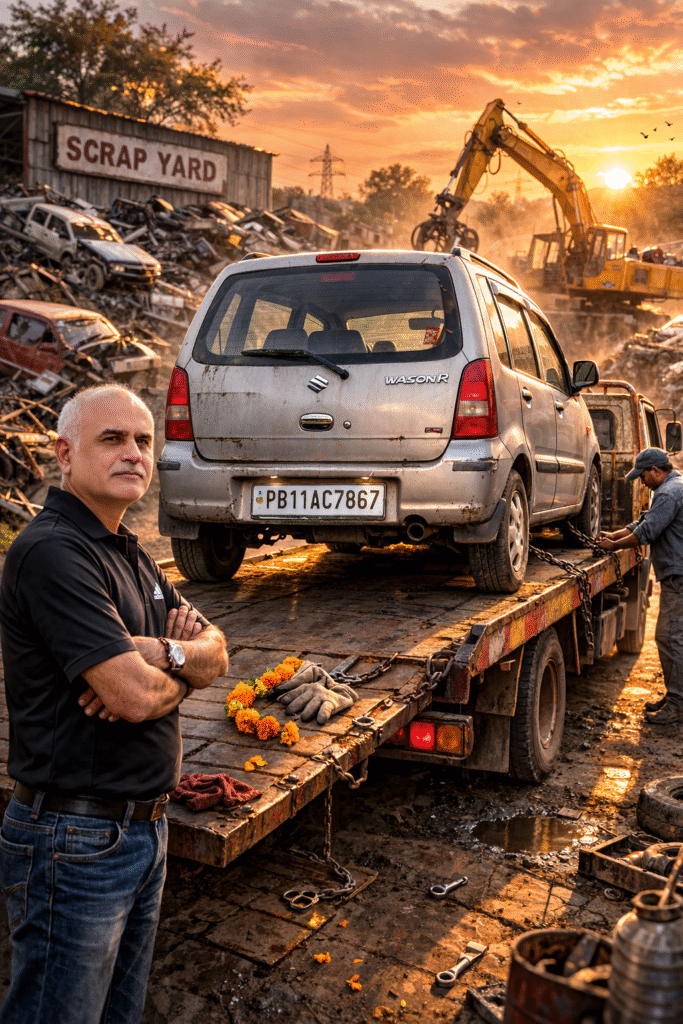
 It feels like someone in the family is due to depart on her final journey to the scrap yard, the ‘her’ here refers to our beloved hatchback Wagon R LXI, purchased twenty years ago in Feb 2006. This association has been a cherished one, as she covered the length and breadth of the country in these past twenty years, moving along with us. It was lucky, no doubt, with its registration number being ‘7867’.Life of our (fauji fraternity) cars are like that, for most of us, especially the ones who are newly minted veterans or the seasoned ones, the current generation is of course a little different where use and throw model is more prevalent and such long associations may not even last with their respective spouses.

Be that as it may, this one is highly nostalgic, after all she saw our kids grow up, when Ananya, my daughter would plonk herself right behind the driver’s seat and sing her nursery rhymes into my ears to driving the car herself as a doctor while in Delhi. My son, Abhijat, took his first driving lessons on this in Secunderabad managing to crash it into a tree, its first of the many brushes with minor and major accidents. Memories of our pet Labrador ‘Buddy’, who was brought home in Wellington and finally took his final journey too while in Delhi in our dear ‘Wegu’, as my children lovingly called her. She is widely travelled, from Chandigarh to Patiala, thereafter to Simla, Kasauli a number of times and then it braved the arduous route to Badrinath, Kedarnath via Dehradun, Rishikesh. When it was time to move to Wellington, she enjoyed the curves, as much as we did. In Secunderabad, she successfully managed to keep herself safe from the two wheeler borne fidayeens, who emerged from any and every angle. While in Delhi she suffered the traffic jams, as my better half Preeti moved from tutoring the inder privileged kids to training the budding Air Hostesses in Frankfinn, but except for minor brushes here and there, she survived without any major blemish. Soon we moved to Ranchi, her stint in Dipatoli Cantt was quite relaxed, as being in a small town, she enjoyed the well deserved retreat, after a hectic Delhi stint. It was back to Delhi soon and once again she was on the road crisscrossing the length and breadth of NCR, generally attending to social dos, weddings etc, as official travel was now in the Staff Car. It was time to move to Udhampur, once again, she was back in the hills and enjoyed our drive to Katra, at the feet of Mata Vasihno Devi, as also the not so frequent jaunts to Jammu, Patni Top etc. Although she was getting on in age, nearing 15 years, when she could have opted for a VRS, we chose to stick with her, getting her registration extended for another five years.

 When we moved back to Delhi, she participated in the fight against Covid, as Dr Ananya was required to report for duty in the Base Hospital. But then Delhi cops are not the ones to indulge in any nostalgia, so one fine day, when we were taking a trip to Manesar, they caught up with us, despite my pleas of being an army officer, a DIG in NSG, which fell on deaf ears, I was asked to return to my residence and not drive the vehicle in Delhi. I had written about this vehicle discard policy earlier, (https://thesuyashsharma.com/kar-bekar/#comments). So, a decision was taken to bring the car to Indore, my hometown, leave it with my parents. We drove down this 17 years old convertible (in human years about 70 plus) and not once did she create any problem en route. She was the mainstay in both the weddings at home of my son Abhijat and Ananya, in fact both of them chose to be driven in their ‘Wegu’ after the rituals, wanting to make their spouses also part of this family tradition. 

She has braved the Indore-Mhow road which of late has more potholes than flat pieces of ground, which in fact helped us decide in favour of settling down at Indore rather then Mhow. Now with more than 100000 kms on the road, I think it is time to give it much needed rest. Incidentally, she has a younger sibling too now, though she is much bigger in size, a Kia Seltos, who joined the family in Jun 2023. Although in hindsight a newer model of dear old reliable Wagon R may have been a better choice, given the condition of traffic in the city and unlikelihood of any major road travels in the foreseeable future. Hopefully she will see us through for the next twenty years. Adios Wegu, RIP.
LADAKH:A STORM IN THE TEACUP


The storm in the tea cup in Ladakh raised allegedly  by the unpublished book by Gen Narawane, whose excerpts appeared in a magazine some time ago, refuses to die down. This time it was Rahul Gandhi who raised the issue in the parliament, seeking clarification from the govt. As per parliamentary procedure and traditions, the President’s address is not the appropriate occasion to raise this issue, as the responses have to be restricted to the matters included in the address per se. But notwithstanding that, the issue having been raised in public on earlier occasion as well, the treasury benches should have responded in a befitting manner rather than brusquely obfuscate it blatantly. Obviously the opposition parties will draw political mileage out of any such developments. Government on its part should have assured the LOP that the issue will be responded to in the parliament after the President’s address and the responses thereto have been gone through.

While politicking may continue, the more pertinent issue is the veracity of the claims published in the Caravan magazine. If, as claimed in the article, these are excerpts  from the unpublished memoirs of Gen Narawane, former COAS, then it is a matter of concern. Firstly, a COAS knows that any incident on the Line of Actual Control (LAC) with China is a sensitive one and falls in the category of classified subjects. He is also aware that he has to seek permission from the govt before publishing anything which may be detrimental to India’s security concerns. For the record, Henderson-Bhagat report on 1962 Sino-Indian conflict is still kept under wraps, so any outstanding issue, in the current scenario, ‘the stand off’, which is yet to be resolved in its entirety, will obviously not be declassified so early. If the COAS was aware, then how could he permit the publisher to release the excerpts for publication? If he did not permit it, then why hasn’t he come forward to castigate the publisher and sued him for breach of trust and contract? So was there a tacit understanding, that such a revelation would ignite a controversy which will help the sale of the book and will work as a teaser for the potential buyers? The only person who can clarify these issues is the author himself and he should come forward to clear the air once and for all.

The issue of lack of any directive from the govt for a considerable period of time, on the reported movement of the Chinese tanks in the disputed area, puzzles me. There are explicit instructions on any such violations with the formations and the commanders at the appropriate level address them as per the protocol, keeping the higher HQ in picture. When a senior commander feels that a different set of actions are to be taken, he issues orders accordingly, again keeping his hierarchy informed.  The commanders looking over their shoulders for instructions at such critical junctures is a sure recipe for disaster. The Corps Commander in this case would have had near four decades of experience and  was thus entrusted with such a crucial assignment of safeguarding the LAC. The predicament faced by the commander is essentially whether he should play safe, seek directions or take command decisions. In my opinion, these are the moments when the Tiger in him must awaken to give clear directions to the subordinates rather than await orders. Similarly, up the chain, commanders were passing the buck rather than tackling the bull by the horns. One understands that matters with China are not the same as they are with Pakistan, but this pusillanimity puts a question mark on their professionalism itself. We have had instances when Generals have disobeyed orders, Lt Gen Harbaksh in 1965 Indo-Pak war and Maj Gen (later Lt Gen) Sagat Singh in 1967 NathuLa. In both the cases their stand was vindicated. As the adage goes, ‘no risk no gain’, commanders ought to trust their own judgement as they are in situ and have a much better understanding of the tactical picture.

Government on its part has also not covered itself with glory, as in the first instance itself, the response should have been the same which appeared after what reportedly took almost three hours plus, “Jo Uchit Samjho Wo Karo!”  giving the commander a free hand in dealing with the situation. Commanders thus must rise to the occasion and be prepared to face the consequences, that is the essence of military leadership.

DEFENCE BUDGET:AN ANALYSIS


It is that time of the year once again, when the projected and planned income expenditure statement for the country is presented in the parliament, referred to as annual budget exercise eagerly looked forward to by all and sundry. Budgetary allocation for different sectors is  an indication of government’s priorities. For a developing nation like ours given our security paradigm, it is a delicate balance and the debate on guns versus butter has to be tackled in a nuanced manner to ensure that the defence gets adequate boost while economic upliftment of the masses is not compromised either.

Defence budget outlay over the last few years has been steadily rising, with almost 40% increase over the last five years in nominal terms, with this year allocation touching a record ₹7.85 lakh, up 15.2% from last year’s   budgeted ₹6.81 lakh crore. Last year, when the budgetary provisions for capability development and modernisation was pegged at  ₹1.86 lakh crore at the RE stage, this year it has been enhanced to ₹2.19 lakh crore, a substantial increase of 21.84%. In view of OP SINDOOR last year and in the current geo-strategic uncertainty, a fillip to the defence expenditure was expected. ₹63,733 crore for aircraft and aero-engines, ₹25,023 crore has been allocated for the naval fleet, while ₹3.65 lakh crore has been allotted under the Revenue Head for operational needs, including daily running expenses like ammunition, fuel, salaries and repairs. ₹1.71 lakh crore has been set aside for defence pensions, about 21% of the total budgetary provision. As is evident, the Revenue expenditure continues at almost 62.5% of the overall financial allocation, which leaves just about 37.5% for modernisation needs. In this hi tech era, where warfare itself has been revolutionised, in the form of Cyber, Space, Drones, AI, Missiles and Rockets, India desperately needs to invest in indigenisation of its armaments as also in  Research & Development, as our principal adversary to the North is miles ahead of us and has much deeper pockets. 

We have made a little progress in the last couple of years, with domestic defence productions touching around ₹1.51 lakh crore in FY 24-25, an 18% increase over the previous year. We have also taken some measures to boost our defence exports, which have risen to almost ₹23000 crore, primarily radars, torpedoes, electronic warfare systems, patrol boats, helicopters and missile components. India though continues to be the second largest arms importer, after Ukraine in the world as per Stockholm International Peace Research Institute (SIPRI).We are still largely dependent for aircrafts, as Tejas is still a couple of years away from assuming the mantle of our mainstay in the skies. Similarly the  missile air defence systems, the likes of S-400 are all ex-import. The latest budgetary provision of exemption in Basic Customs Duty (BCD) caters to full duty exemption on components and parts as also the raw materials imported for the manufacture of parts used for maintenance, repair and overhaul (MRO) civilian, training and other aircrafts, should provide a boost to the fledgling domestic aerospace industry.

While all the measures taken are welcome, all these amount to incremental changes, rather than any bold steps towards providing impetus to private defence industry towards their expenditure in research and development. The DRDO and PSUs receive the lion’s share of almost 77% and the private sector getting the rest. The former have a very poor track record of deliverance and hence strong checks and measures are imperative, with active involvement of defence services themselves. Private sector has benefitted as they have been banking on the defence veterans providing them the necessary technical expertise. The other major reform which has been pending is the long over due de-linking of pensionary benefits with the defence budget, as it shows an inflated figure, while the actual availability of funds stays around 1.9 -2% of GDP, as against US 3.4%, of $850 billion, of  which 35-40% is for capital expenditure and Chinese1.7% (actual figures may be much higher) of $ 290 billion, of which 30-35% is capital expenditure, as against ours which is pegged at 25-27% of $82 billion ( figures are from 24-25 defence budgets). Agniveer system was resorted to primarily to address this aspect, but the Defence Civilians (who serve till 60 years of age, as against the uniformed personnel who retire at 35 on an average) continue to form almost 45% of the pensionary expenditure, who could be transferred to another suitable head, making the picture more realistic. Nevertheless, it is a budget which is on the right lines.

GREENLAND: LA LA LAND


 Is Greenland the latest toy which has got the fancy of this kid Don, after having caught Maduro in his favourite game of ‘I spy’? It appears so, the brat knows it can bully, throw tantrums and get anything that he wants. EU has almost succumbed, only China has had the guts to look him in the eye and no surprises, it has been spared the blushes. India too has been defiant, but since we do not have the heft, we have been at the receiving end. Although, he has been professing his friendship with PM Modi all the while when he has been burdening us with additional tariffs thrown our way.

So why Greenland, that is the question, when it will definitely wreck the NATO and that would in a way be playing into the hands of arch rivals Russia? US interests In Greenland is not something which Trump has suddenly dreamt about, way back in 1946 President Truman had intended to buy it from Kingdom of Denmark for  $100 million, having realised its geo-strategic significance in the Arctic. During the Second World War too Greenland was occupied by US troops and acted as a major Submarine choke point along with Iceland and UK. Since 1951 US has had its military bases in Greenland as part of NATO.

Greenland is rich in resources with a sparse population of just about 58000, with its per capita GDP also around $58000. The resources include Rare Earth Minerals like Lithium, estimated Oil and Gas reserves worth 31 billion barrels of oil equivalent (BOE, the amount of energy contained in one barrel of oil), fresh water and fisheries. With the rise in global temperatures the sea routes in Arctic will also be more navigable, thus making Greenland a critical asset. It is being sought by Trump, not as a trophy but primarily for extending his reach and control in the Arctic. But can he not do this under the current arrangements rather than infringe on their sovereignty and jeopardise NATO itself? He can but then Trump’s offer of outright financial transaction  for the island is not a novel one either with acquisition of Alaska from Russia in 1867 and Woodrow Wilson’s purchase in 1917 of US Virgin Islands from Denmark itself as precedences.

How are the global powers effected by this turn of events, well obviously there is widespread criticism by all, but the reactions are so far muted and even those  by Denmark and European NATO nations have been purely notional in the form of increasing their military presence, which can hardly be described as show of force. India is keenly watching the developments, as although, it has not evinced any interests in the Arctic, being Indo-Pacific centric primarily, but such an acquisition may embolden China into initiating similar actions in island territories in the Atlantic or the Indian Ocean as well, is the major cause of worry. Moreover the global order which is facing turbulence at the moment may end up in a free for all, a situation akin to pre World War 1 when the colonial powers were busy acquiring new colonies. The multi-polarity in the world which is actively being pursued by India and other major nations will be given a quiet burial with pronounced US hegemony making it a unipolar one again.

What are the options with Greenland Denmark or the NATO? Firstly Greenland may offer US more bases and freedom to explore minerals still maintaining a semblance of its sovereignty, failing which it will be at the mercy of the US. Denmark may not get much of a say despite being the controlling nation, as  Greenland enjoys autonomy and may choose its own path. NATO itself may have to finally acquiesce as it is neither in a position to confront the US militarily nor diplomatically. They may resort to some face saving gestures though, getting Greenland to pass the resolution in favour, thereby accepting people’s mandate.

Will US actually benefit in the short term by this action, highly unlikely, long term may be, but the major gain is signalling to China as also NATO as to who calls the shots in the global arena. China still has at least a decade before it can pose any kind of challenge to US, so this is the moment which Trump is keen to seize, which may end up delaying China’s rise as well. So Greenland is no La la land for Trump, the pursuit is serious.

KAI PO CHE

 Kai Po Che…”, “Katta Hai…”, “Wo Katta…”could be heard emanating from the rooftops, sounding almost like war cries, it was like I had taken the time machine and travelled back to my childhood days. This year on the occasion of Makar Sankranti I spotted some kites flying gloriously in the sky unchallenged and I was reminded of the times when kite flying was not just a hobby but a passion  with the residents in the Hindi heartland, especially on the occasion of Sankranti 14 Jan and Independence day in and around Delhi. Alas in today’s gadget dominated world, these simple pleasures are losing out.

Flying kites is an art as also a science, you can’t just pick up one and tie the thread to it and expect kites to take to the sky by just wishing it to do so. No sir, firstly you have to identify a good kite, whose support sticks (called ‘kaman’ in local parlance)  are not too rigid, just flexible enough for it to gently flow in the wind. Then the way the thread is tied to the kite has to be perfectly balanced, with two pin holes on the  top cross of the support sticks and two pin holes somewhere at the three-fourth length, where knots are tied and then a triangular thread (called ‘Jota‘ here) connects these two ends. Now your kite is ready to do your bidding, provided you have done some preliminary recce, as to the wind direction and clearance, lest it get stuck in a tree or a wire immediately on soaring from the ground level. 

Growing up in Dhar, a small town in MP, kite flying during the winters specially around Sankranti was something which we kids keenly looked forward to. The passionate ones would prepare the thread (Manja) weeks in advance, with glue and glass pieces (obtained from fused bulbs and tube-lights generally), to sharpen the threads so that they can vanquish the opponent’s kites in the sky followed by ‘Katta Hai’, the victorious war cry with unmatched pride. Kite flying was fun, but looting them was even more fun, as the kites which lost the duel (pench ladana), would be floating in the sky free, without any mooring and were free for picking, ‘finders-keepers’ was the accepted norm. There were groups of boys who would be armed with big bamboo sticks to catch these kites in the air and grab them. 

Kite flying probably originated in China and travelled to India, although it is also mentioned in the ancient Hindu religious texts Ramayana at places. In one incident Hanuman is supposed to have recovered Bhagwan Ram’s kite from the Indralok (heaven where Indra and the Devtas reside). During the Mughal period kite flying was pursued as a sport by the rich and nobility. The most famous kite flying incident in the scientific domain, of course, was in USA when Benjamin Franklin’s experimented in 1752, when he flew a silk kite with a metal key in the rains to demonstrate that lightning was electricity.

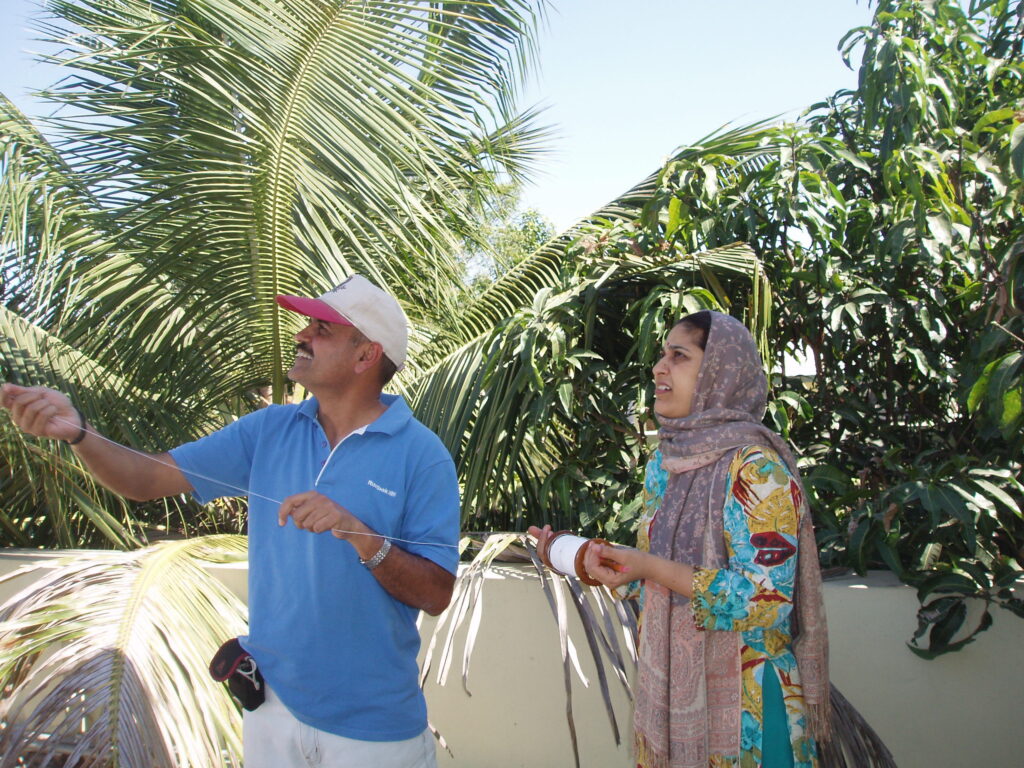
In the modern era, there are International festivals organised in Gujarat and Telangana, where aficionados from all over the world come and participate displaying their unique kites and skills. Although I am not much of a kite flyer myself, but I have enjoyed doing it once in a while. Once when we were at Secunderabad, I actually flew one to demonstrate it to the kids, who have not been exposed to it at all.  

OLYMPUS DIGITAL CAMERA

We may draw our own lessons from this experience, given the right environment, a simple piece of paper  also flies mighty high but it stays there only as long as it does the bidding of the flyer, as he controls its ascent, descent and height as also the way it performs in the duels, where sometimes it is given enough leeway, so that the opponent loses patience and the kite both, or sometimes going on the offensive right from the word go and taking the adversary by surprise thereby emerging a winner. While we may wax eloquent about all these life lessons about life, finally all this comes to a nought when we are asked to go ‘fly a kite’ by the boss at work as also at home. But seriously find time and enjoy this activity once in a while, re-live your childhood.

Vigilantism in Venezuela


‘Discretion is better part of valour’, that is one lesson which friend Nicolas Maduro would probably have learnt a little late though. Venezuela is a sovereign nation and has its rights, but then it also has world’s largest oil reserves and apparently even huge deposits of silver. While it may be a blessing, but the boon has actually turned into a bane as when you antagonise the Global super bully and hob-knob with its rivals, or start planning to trade in any currency other than US$, you know you are living dangerously, especially if you don’t have the muscle to protect yourself. 

Venezuela was a relatively stable country known as the global capital of beauty pageants, as their lithesome lasses trumped the other contestants 23 times in the last seven odd decades. Then Hugo Chavez came to power with his Marxist socialist ideology and spate of nationalisations followed, resulting in the American companies being forced to extricate. Having seen something similar at close quarters in Cote d’Ivoire in the first decade of this century, when Ivorians decided to cast their lot with anti-French politicians (their colonial masters), the country plunged into a civil war. Finally the UN Peacekeepers stepped in but it was the French who brokered peace and  the French companies returned to take over from where they left and the country is peaceful. The same script will be replayed here, American businesses will flock to this resource rich nation and all will be well.

Americans are known to have effected regime changes whenever it suits them, the excuses could be weapons of mass destruction to drugs but the actual reason is the threat posed to the hegemony of Petro$. As is well known, after Kissinger convinced the Saudis that oil trade would be in American$ only in return for addressing their security concerns, dollar became the fiat currency and rest of the world had to tow the line. Whenever there was an attempt to get out of this Dollar stranglehold by any country, the ruler was toppled and anarchy followed, be it Iraq, Saddam Hussein or Libya – Gaddafi. Maduro too was toying with the idea of joining BRICS and trading oil in Chinese Yuan, that was the sin he committed for which he has been abducted and brought to the US for standing trial for some supposed drug related offences.

The American actions are in blatant violations of international norms and has invited criticism from the UN as also from China and Russia, but that is mere tokenism as there are no actions which are envisaged by any of them individually or collectively. May be both China and Russia are in a way looking forward to exploiting this precedence in their respective backyards themselves in times to come. There are major lessons for smaller countries here, firstly avoid getting into a confrontationist mode with a bigger power and secondly before aligning with any rival powers weigh the pros and cons. Flirting with Russia and China, knowing fully well that they are not in any way capable for standing up for Venezuela in case of any eventuality should have acted as a deterrent. 

There are lessons for India as well, although we are a much bigger and more powerful nation, the first one being standing up for its own principles. India has always followed the righteous path and weathered many a storm in its nearly eight odd decades of independent existence. Sovereign nations have rights to choose their systems of governance, their allies, their economic model and so on, but more importantly they need to be able to safeguard their interests. If that fails then the sovereignty itself is questionable. India has managed to weather the tariff tantrum by skilful diplomacy so far, addressed the currency issue also by resorting to trades in rupee, rial, rouble or yuan as the case may be. Diplomacy requires deftness and hence we have consciously chosen not to rebut or provoke even some unfounded claims during OPERATION SINDOOR. We need to be on our guard as the global situation is rather volatile and global institutions and watchdogs have more or less become defunct, in an eerie similarity to events pre second world war, when League of Nations collapsed.  

To SIR with Love

 The old timers would recall, a movie starring Sydney Poitier and Lulu based on the life of the  autobiography of  ER Braithwaite, Lulu’s iconic song in the climax “To Sir with love…” is simply legendary. In fact, the movie itself still remains etched in my memory, as though I saw it yesterday, even after more than four decades. This one may come as a surprise to most of you but this SIR, is not your teacher as you know them, but it ends up teaching you a number of lessons alright. The SIR, I am referring to, is the Special Intensive Revision of the Voter List, currently in progress in a number of states in India.

Having led a nomadic existence in the last five decades , since I joined RIMC as an eleven year old, this rolling stone gathered no moss nor a Voter ID. A mandatory requirement to participate in the democratic process in the country. But then someone has to guard the borders, so while the election festival is celebrated with much fanfare in the rest of the country, we faujis have to watch the fun from the sidelines. Earlier, we never received the postal ballots, then when we started registering where we were posted, we landed up in Jammu & Kashmir, where we were again denied our fundamental right. But all that was part of life that we had signed up for, so no cribs. Now having superannuated and back in the civil world, it was time for us to be counted so we registered ourselves as Voters in Mhow last year and duly cast our votes in the Assembly Elections. 

Then this SIR hit us, requiring us to link our names with the 2003 Voter List. That was a tall order, as in 2003 we were in Ladakh and obviously did not figure in any list anywhere in the country. I was told that all that was needed was my parents names in the 2003 list, so in all earnestness I set out to get the missing link. I am quite sure mankind was not so earnest in finding the elusive missing link in evolution of Homo sapiens as I was, after all it was my citizenship which was at stake. The threat of being labelled a Bangladeshi or a Rohingya in disguise was enough to send me scurrying to the Booth Level Officer (BLO). The BLOs are actually teachers who have landed up with this millstone around their neck, who have the highly unenviable task of tracing the voters in the booths assigned to them and then getting the necessary documentation done. The task given to them actually is one fit for ghosts (Bhoot), because only a bhoot can find the missing people in the voter list. As it is, it is reported that quite a few of these listed voters themselves have kicked the bucket and may themselves be ghosts watching the fun from some of the old Peepul Trees or from the graveyards.

Anyway, having been served a notice that we were the unmapped types, we were required to present ourselves to the BLO, who directed us to the Tehsil Office for submitting  the required documents to prove that we were bonafide citizens of Bharat. Being conscientious and sincere, I meticulously  collected almost all the documents listed, a Govt issued identity card, my veteran card, my  Pension Payment Order (PPO), my Passport, copy of registry of property, High School Certificate and so on. The officer, despite being on leave, was kind enough to entertain us and accepted our claim with the documents presented. I am hoping that with this presentation of documents To SIR with Love, the saga would come to a happy end. I just hope that the name is entered correctly, as I was told by my friend Akash, that his father’s name in the list was entered as Bigdey (बिगड़े) Bhanot instead of Brigadier Bhanot. So keeping my fingers crossed….